


Forest Clean-up and Restoration - Trans Canada Trail, Burnaby
ISCMV Spring Forum & AGM 2026 - VanDusen Botanical Garden
Stewardship Series: Closing the Gap
Earth Fest - Everett Crowley Park, Vancouver
Earth Day - Stanley Park, Vancouver
Seeding Stewardship Fair
Glenbrook Ravine Invasive Removal - Nov
Native Species Planting - Glenbrook Ravine
Glenbrook Ravine Invasive Removal - Oct
Eco-Fest & Weed Pull - Glenbrook Ravine
Glenbrook Ravine Invasive Removal - June
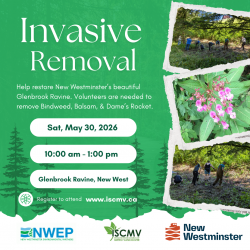
Glenbrook Ravine Invasive Removal - May
Glenbrook Ravine Invasive Removal - April
Glenbrook Ravine Invasive Removal - March
Ready, Set, Pull! - Ladner Harbour Park, Delta - Sept
Ready, Set, Pull! - Mackie Park, Delta
Ready, Set, Pull! - Pebble Hill Park, Delta
Ready, Set, Pull! - Ladner Habour Park, Delta
Reclaiming our Relationship with our Plant Kin - Chenchenstway, Vancouver
Native Planting - Robert Burnaby Park - Nov 2026
Invasive Removal - Robert Burnaby Park - September 2026
Invasive Removal - Robert Burnaby Park - July 2026
Invasive Removal - Deer Lake - July 2026
Invasive Removal - Deer Lake - June 2026
Invasive Removal - Deer Lake Park - May 2026
Native Planting - Central Park - November 2026
Invasive Removal - Central Park - October 2026
Invasive Removal - Central Park - September 2026
Invasive Removal - Central Park - August 2026
Invasive Removal - Central Park - June 2026
Invasive Removal - Central Park - May 2026
Invasive Removal - Central Park - April 2026
Invasive Removal - Burnaby Mountain - July 2026
Invasive Removal - Burnaby Mountain - April 2026
Stewardship Series: The Battle for Biodiversity
Invasive Species Walk - VanDusen Garden, Vancouver
Invasive Plant Removal - Garden City Park, Richmond
February Work Party - Jericho Beach, Vancouver
Environmental Stewardship - Everett Crowley Park, Vancouver
Invasive Pull - Champlain Heights Trails, Vancouver
Evening at the Museum - PoCo Museum & Archives
Invasive Species Virtual Fall Forum
Nature is for Everyone Planting - Champlain Heights Trails, Vancouver
Environmental Stewardship - Invasive Pull & Planting - Everett Crowley Park, Vancouver
Robert Burnaby Park Planting
Oregon Ash Seed Collection Workshop - Virtual
Holiday Card Making With Invasive Plants - Stanley Park, Vancouver
Detecting Emerald Ash Borer in Greater Vancouver
Coast Salish Plant Walk with Cease Wyss
ISCMV Spring Forum & AGM 2025 - Champlain Heights Community Centre, Vancouver
In-Person Pesticide Applicator Course - University of the Fraser Valley, Abbotsford
Meadow Making - Cornett Road, Vancouver
Path to Restoration: Stewardship Clean-up - Nootka & 14th, Vancouver
April Work Party - Jericho Beach Park, Vancouver
Park Stewardship - Everett Crowley Park, Vancouver
Free the Fern Invasive Pull - Red Alder Trail, Vancouver
Native Planting - Glenbrook Ravine, New Westminster
Invasive Pull - Glenbrook Ravine, New Westminster
Invasive Pull - Glenbrook Ravine, New Westminster
Invasive Pull - Glenbrook Ravine, New Westminster
Invasive Pull - Glenbrook Ravine, New Westminster
Resilient Restorations: Sustainable Gardening Solutions - Como Lake Park, Coquitlam
Community Planting - Central Park
Burnaby Stewardship - Central Park
Burnaby Stewardship - Central Park
Burnaby Stewardship - Central Park
Burnaby Stewardship - Deer Lake
Burnaby Stewardship - Deer Lake
Burnaby Stewardship - Central Park
Burnaby Stewardship - Deer Lake
Burnaby Stewardship - Central Park
Burnaby Stewardship - Burnaby Mountain
Burnaby Stewardship - Deer Lake
Burnaby Stewardship - Deer Lake
Burnaby Stewardship - Central Park
Burnaby Stewardship - Burnaby Mountain
Burnaby Stewardship - Central Park
Wildlife Friendly Gardening - VanDusen Gardens, Vancouver
Other Invasive Species
Profiles for a selection of high priority regional invasive species can be found below.
| Image | Name | Description | Fact Sheet | BMPs |
|---|---|---|---|---|
|
Photo Credit: Alisha Switzer |
American BullfrogLithobates catesbeianus |
Bullfrogs are voracious, unspecialized predators, eating a variety of prey, including native frog species. | Tackling American Bullfrog - July 2023 | Best Management Practices for American Bullfrog - August 2021 |
|
Photo credit: Bruce Watt, University of Maine, Bugwood.org |
European Chafer BeetleAmphimallon majale |
European chaffer beetle larvae can damage turfgrass, lawns, and sports fields. | Tackling European Chafer Beetle - August 2021 | Best Management Practices for European Chafer Beetle - August 2021 |
|
Photo credit: Sean McCann |
European Fire AntMyrmica rubra |
If disturbed, European fire ants will repeatedly sting people, pets and wildlife that come close to their nests. | Tackling European Fire Ant - August 2021 | Best Management Practices for European Fire Ant - August 2021 |
|
Photo credit: Joseph Berger, Bugwood.org |
Japanese BeetlePopillia japonica |
Japanese beetle is a destructive insect, known for its voracious appetite and ability to quickly defoliate plants, damaging landscapes and reducing crop yields. | Tackling Japanese Beetle - October 2023 | Best Management Practices for Japanese Beetle - October 2023 |


Invasive Species Walk - VanDusen Gardens, Vancouver
Spring Seminar 2025 - Michael J Fox Theatre, Burnaby
Ready, Set, Pull! - Kittson Parkway Environmental Reserve, Delta
Ready, Set, Pull - Forest Bay Park Reserve, Delta
Ready, Set, Pull! - Ladner Harbour Park, Delta
Invasive Plants

Priority Lists
Considering localized species and management programs in Metro Vancouver, the ISCMV has developed a risk ranking tool for invasive plants.
Invasive plant species are also prioritized at a Provincial scale:
- Priority Invasive Species in B.C. list
- 2025 Provincial Public Land “Top 25” Invasive Plant Species Priorities
- B.C. Weed Control Act & Regulation
- B.C. Invasive Plant Core Ranking Process
- B.C. Invasive Plant Candidates for Eradication are candidates for the B.C. Early Detection Rapid Response (EDRR) Program. The following EDRR candidates are found in Metro Vancouver: water lettuce, mouse ear hawkweed, North African grass, Spartina species, shiny geranium (NEW - to be confirmed), yellow floating heart, Brazilian elodea, Dyer's woad, Phragmites. The status of management of these plants is available here.
Invasive Plants in Metro Vancouver
This list represents a selection of some of the most common invasive plant species found in our region. Contact us if you are looking for resources for other invasive species not listed.
Download this flyer for tips on hiring a qualified contractor if you're looking to have invasive species professionally treated on private property.
| Image | Name | Description | Fact Sheet | BMPs |
|---|---|---|---|---|
 |
BambooVarious species |
Bamboos are a large group of fast-growing, perennial, woody-stemmed evergreen grasses. |
Tackling Bamboo - June 2024 |
Best Management Practices for Bamboo - June 2024 |
 |
Butterfly BushBuddleja davidii |
Butterfly bush is a hardy, fast-growing deciduous shrub that invades both disturbed and natural areas. |
Tackling Butterfly Bush - June 2023 | Best Management Practices for Butterfly Bush - June 2023 |
 |
Cherry LaurelPrunus laurocerasus |
Cherry laurel is a fast-growing woody evergreen tree or shrub with toxic leaves, stem, and seeds. |
Tackling Cherry Laurel - July 2024 | Best Management Practices for Cherry Laurel - July 2024 |
 |
Common PeriwinkleVinca minor |
Common periwinkle is a low-growing trailing evergreen plant that forms extensive mats on forest floors. |
Tackling Common Periwinkle - July 2024 | Best Management Practices for Common Periwinkle - July 2024 |
 |
English & Irish IviesHedera helix & Hedera hibernica |
Ivy is an evergreen vine that forms dense monocultures along the ground and up trees and structures. |
Tackling English and Irish Ivies - August 2021 | Best Management Practices for English and Irish Ivies - August 2021 |
 |
English HollyIlex aquifolium |
English holly, with its bright red berries and dark green evergreen foliage, can suppress native vegetation over large areas. |
Tackling English Holly - August 2021 | Best Management Practices for English Holly - August 2023 |
 |
Garlic MustardAlliaria petiolata |
Garlic mustard is one of the fastest spreading invasive plants in woodland and edge habitats in North America. |
Tackling Garlic Mustard - July 2023 | Best Management Practices for Garlic Mustard - June 2022 |
 |
Giant HogweedHeracleum mantegazzianum |
Giant hogweed is a high priority species in the region primarily due to the potential health impacts from direct contact with the plant. |
Tackling Giant Hogweed - July 2023 | Best Management Practices for Giant Hogweed - August 2021 |
 |
Hedge BindweedCalystegia sepium |
Hedge bindweed can quickly overwhelm other vegetation, growing between, around and over other plants. |
Tackling Hedge Bindweed - July 2023 | Best Management Practices for Hedge Bindweed - August 2021 |
 |
Himalayan BalsamImpatiens glandulifera |
Himalayan balsam is a summer blooming annual plant that produces abundant seeds in capsules that explode when ripe. |
Tackling Himalayan Balsam - August 2021 | Best Management Practices for Himalayan Balsam (including special mention of small-flowered touch-me-not) - August 2021 |
 |
Himalayan BlackberryRubus bifrons |
Himalayan blackberry was first introduced in British Columbia in the nineteenth century as a berry crop, but has more recently been recognized as an invasive species. |
Tackling Himalayan Blackberry - August 2021 | Best Management Practices for Himalayan Blackberry - August 2021 |
 |
KnotweedsVarious species |
Knotweeds vigorous rhizome growth can damage concrete walls, pavement, bridges, foundations, and drainage networks. |
Tackling Knotweeds - August 2021 | Best Management Practices for Knotweeds - February 2024 |
 |
Orange HawkweedPilosella aurantiaca |
Orange hawkweed is a perennial herb that is more widespread than other non-native hawkweeds because it has repeatedly escaped cultivation. |
Tackling Hawkweed - June 2023 | Best Management Practices for Orange Hawkweed - June 2023 |
_cropped.JPG) |
Parrot's FeatherMyriophyllum aquaticum |
Parrot’s feather is a perennial aquatic plant that can contribute to a loss of plant and aquatic species diversity. |
Tackling Parrot's Feather - August 2021 | Best Management Practices for Parrot's Feather - August 2021 |
 |
Poison HemlockConium maculatum |
Poison hemlock plants are poisonous when ingested and toxicity can also result from inhalation and skin contact. |
Tackling Poison Hemlock - July 2023 | Best Management Practices for Poison Hemlock - June 2023 |
 |
Purple LoosestrifeLythrum salicaria |
Purple loosestrife can grow as a monoculture, reducing biological diversity at the site of infestation. |
Tackling Purple Loosestrife - August 2021 | Best Management Practices for Purple Loosestrife - August 2021 |
_cropped.JPG) |
Reed CanarygrassPhalaris arundinacea |
Reed canarygrass forms dense, persistent, monocultures in wetlands, ditches, floodplains, and wet meadows. |
Tackling Reed Canarygrass - August 2021 | Best Management Practices for Reed Canarygrass - August 2021 |
_cropped.JPG) |
Scotch BroomCytisus scoparius |
Scotch broom is a fast growing shrub that forms dense monocultures, spreading rapidly due to its ability to produce large quantities of long-lived seeds. |
Tackling Scotch Broom - August 2021 | Best Management Practices for Scotch Broom - August 2021 |
 |
Spurge LaurelDaphne laureola |
Spurge laurel is a highly toxic perennial evergreen shrub that, once established, can form a dense shrub layer and outcompete native plants. |
Tackling Spurge Laurel - July 2023 | Best Management Practices for Spurge Laurel - June 2022 |
 |
Wild ChervilAnthriscus sylvestris |
Wild chervil is an invasive herb with deep taproots that spread aggressively, making it difficult to remove. |
Tackling Wild Chervil - August 2021 | Best Management Practices for Wild Chervil - August 2021 |
 |
Yellow ArchangelLamiastrum galeobdolon |
Yellow archangel is an evergreen herbaceous plant that forms dense populations in natural areas, climbing over stumps and smothering native species. |
Tackling Wild Chervil -August 2021 | Best Management Practices for Yellow Archangel - August 2021 |
 |
Yellow Flag IrisIris pseudacorus |
Yellow flag iris grows and spreads rapidly, forming dense colonies and displacing native wetland plants. |
Tackling Yellow Flag Iris - August 2021 | Best Management Practices for Yellow Flag Iris - August 2021 |
Ready, Set, Pull! - Mackie Park, Delta
Ready, Set, Pull! - Pebble Hill Park, Delta
Ready, Set, Pull! - Ladner Harbour Park, Delta
Stewardship - Everett Crowley Park, Vancouver
Understanding Invasive Species and Their Impacts
Ivy Basket Weaving - VanDusen Gardens, Vancouver
ISCMV Fall Forum 2024
Intro to Japanese Beetles
Conservation Connections 2024
Burnaby Stewardship - Central Park - Sept 28, 2024
Wings over Iona
Stewardship Series: Seeds & Stewardship
Emerald Ash Borer Expanded Regulation Area in BC

News Release from the Canadian Food Inspection Agency:
June 28, 2024 - Canadian Food Inspection Agency
The Canadian Food Inspection Agency (CFIA) has updated its regulated areas for emerald ash borer (EAB - Agrilus planipennis) to include an area in British Columbia, in an effort to slow the insect's spread.
The regulated area in British Columbia includes the City of Vancouver, the University of British Columbia (UBC) campus and the University Endowment Lands (UEL). This is the first expansion of the EAB regulated area in British Columbia.
EAB is most commonly spread through the movement of firewood and other infested ash wood products, although it can also spread by flying up to 10 kilometers.
Effective immediately, ash material (such as logs, branches and woodchips) and all species of firewood cannot be moved outside of the regulated area without permission from the CFIA. If you need to move ash material, please contact your local CFIA office to request written authorization.
Although the EAB poses no threat to human health, it is highly destructive to ash trees. It has already killed millions of ash trees in regulated areas in Canada and the United States and poses a major economic and environmental threat to urban and forested areas of North America.
The CFIA will continue to survey and monitor the spread of this pest in British Columbia and will continue to work with federal, provincial, municipal and First Nations partners and organizations to slow its spread.
If you spot EAB outside regulated areas, report it to the CFIA to help stop the spread.
Photo Credit: Debbie Miller, USDA Forest Service, Bugwood.org
Watch & Report Invasive Insects!

(le français suit)
Do you spend time monitoring, photographing or observing insects? If so, your help is needed to watch for and report invasive and migratory insect pests that harm plants, causing damage to Canada’s environment, farm lands, forests, parks and other natural areas. Early detection is critical for slowing the spread of these insect pests.
View the poster for your region (see pdfs below) to learn more about priority insect pests to watch out for. Use the QR code to report your detections!
This initiative is a collaborative project developed by the Insect Surveillance Community of Practice of the Canadian Plant Health Council, a multi-partner body that coordinates action for the protection of plant health in Canada.
Passez-vous du temps à surveiller, photographier ou observer des insectes? Dans l’affirmative, votre aide est nécessaire pour surveiller et signaler les insectes ravageurs envahissants et migrateurs qui nuisent aux plantes et causent des dommages à l’environnement, aux terres agricoles, aux forêts, aux parcs et à d’autres aires naturelles du Canada. La détection précoce est essentielle pour ralentir la propagation de ces insectes nuisibles.
Consultez l’affiche de votre région pour en savoir plus sur les insectes nuisibles prioritaires que vous pouvez rechercher et utilisez le code QR pour signaler vos détections!
Cette initiative est un projet de collaboration élaboré par la Communauté de pratique de la surveillance des insectes du Conseil canadien de la santé des végétaux, un organisme multipartite qui coordonne les mesures de protection de la santé des végétaux au Canada.
Burnaby Stewardship: Deer Lake - July 12, 2024
_250_250_c1.png)
ISCMV Spring Forum & AGM 2026 - VanDusen Botanical Garden
May 26, 2026
Join the ISCMV board and staff as we celebrate our 20th anniversaty at our Spring Forum & AGM
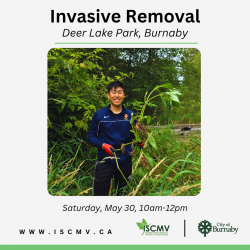
Invasive Removal - Deer Lake Park - May 2026
May 30, 2026
Remove invasive species and help restore Deer Lake Park
Forest Clean-up and Restoration - Trans Canada Trail, Burnaby
May 30, 2026
Join a forest clean-up along the Trans Canada Trail in Burnaby Heights.
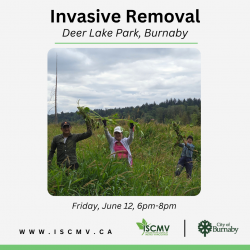
Invasive Removal - Deer Lake - June 2026
June 12, 2026
Help remove invasive plants from Deer Lake Park
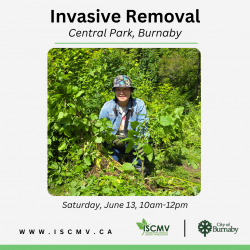
Invasive Removal - Central Park - June 2026
June 13, 2026
Help remove invasives and restore Central Park
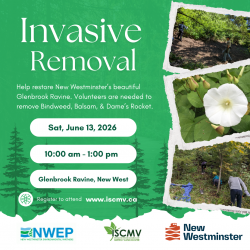
Glenbrook Ravine Invasive Removal - June
June 13, 2026
Help restore the beautiful Glenbrook Ravine park.
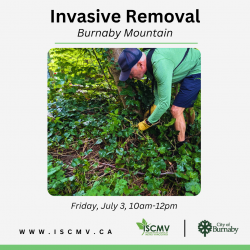
Invasive Removal - Burnaby Mountain - July 2026
July 3, 2026
Help remove invasive plants and restore Burnaby Mountain
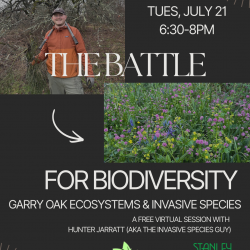
Stewardship Series: The Battle for Biodiversity
July 21, 2026
Hunter Jarratt will share about his effort to remove invasive species and restore garry oak ecosystems
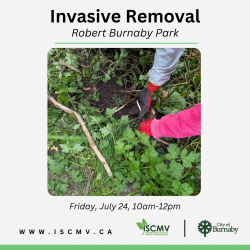
Invasive Removal - Robert Burnaby Park - July 2026
July 24, 2026
Remove invasive plant in Robert Burnaby Park
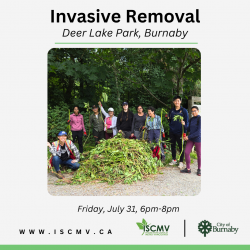
Invasive Removal - Deer Lake - July 2026
July 31, 2026
Help remove invasive species at Deer Lake Park
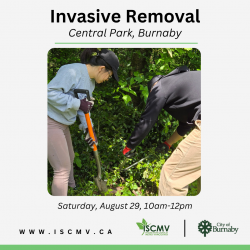
Invasive Removal - Central Park - August 2026
August 29, 2026
Remove invasives and help restore Central Park
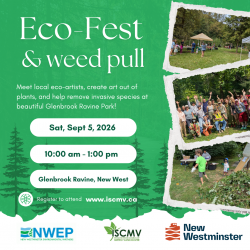
Eco-Fest & Weed Pull - Glenbrook Ravine
September 5, 2026
Create eco-art and help remove invasive plants from Glenbrook Ravine.
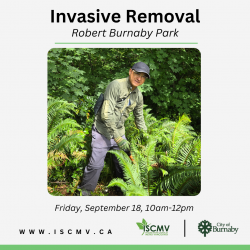
Invasive Removal - Robert Burnaby Park - September 2026
September 18, 2026
Help remove invasive plants from Robert Burnaby Park
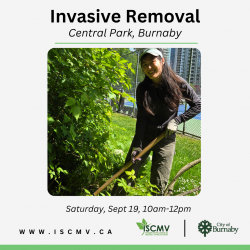
Invasive Removal - Central Park - September 2026
September 19, 2026
Help remove invasives and restore Central Park
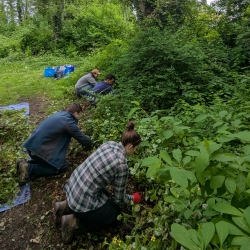
Ready, Set, Pull! - Mackie Park, Delta
September 26, 2026
Help restore the beautiful Mackie Park in Delta
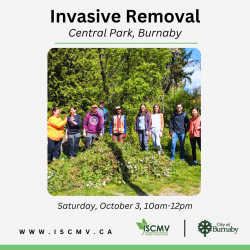
Invasive Removal - Central Park - October 2026
October 3, 2026
Help remove invasives and restore Central Park
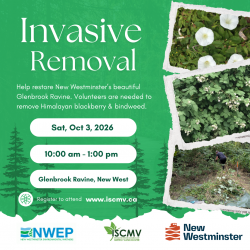
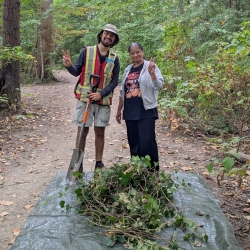
Ready, Set, Pull! - Ladner Harbour Park, Delta - Sept
October 10, 2026
Help restore the beautiful Ladner Harbour Park in Delta
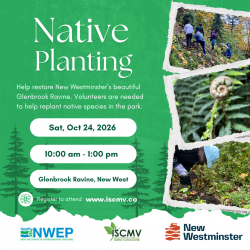
Native Species Planting - Glenbrook Ravine
October 24, 2026
Help replant native species at Glenbrook Ravine park
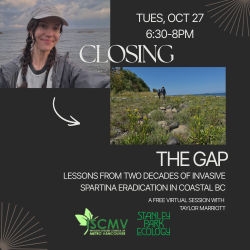
Stewardship Series: Closing the Gap
October 27, 2026
Taylor Marriott will share about the invasive Spartina Eradication Program.
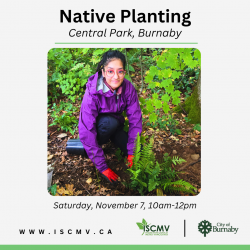
Native Planting - Central Park - November 2026
November 7, 2026
Help replant native species at Central Park
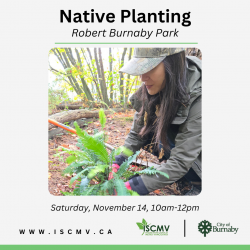
Native Planting - Robert Burnaby Park - Nov 2026
November 14, 2026
Help replant native species at Robert Burnaby Park
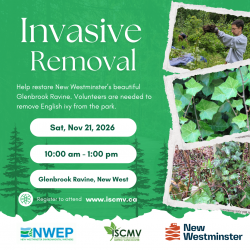
Glenbrook Ravine Invasive Removal - Nov
November 21, 2026
Help restore the beautiful Glenbrook Ravine